
Last updated July 12, 2026
How to Hire a Chimney Cleaning Contractor in Rochester: A Step-by-Step Guide
Here’s a number that should stop you cold: the Chimney Safety Institute of America reports that chimney fires cause over 25,000 house fires annually, and most originate in chimneys that were “recently cleaned” by unqualified operators. In Rochester, where Lake Ontario’s moisture and our freeze-thaw cycles punish masonry year after year, a bad chimney cleaning isn’t just a waste of money — it’s a genuine safety hazard. We’ve spent 20 years in the chimney trade watching homeowners learn this lesson the hard way. This guide gives you the exact questions, red flags, and verification steps to hire a contractor who’ll actually keep your family safe.
Quick Answer
To hire a qualified chimney cleaning contractor in Rochester, verify CSIA certification, confirm the technician who arrives is the same person you spoke with, request a written scope of work with camera inspection included, and check reviews for specific technical details rather than generic praise. Expect to pay $200–$400 for a proper Level 1 inspection and cleaning in the Rochester market — significantly less often signals corners being cut on equipment, insurance, or training.
Table of Contents
- Why CSIA Certification Is Non-Negotiable in Rochester
- The 7 Questions That Expose Inexperience
- Owner-Operated vs. Rotating Crews: What It Means for Your Safety
- How to Read Reviews Like a Technician
- What a Legitimate Estimate Includes (and What Vague Pricing Hides)
- Rochester-Specific Risks: Climate, Codes, and Common Failures
- Why Professional-Grade Materials Matter
- Common Mistakes to Avoid
- When to Call a Professional
- Frequently Asked Questions
- The Bottom Line
Why CSIA Certification Is Non-Negotiable in Rochester
The Chimney Safety Institute of America (CSIA) Certified Chimney Sweep credential isn’t a weekend course or a mail-order certificate. It’s a rigorous program requiring written examination, code knowledge, and continuing education — and in New York State, where building codes adopt NFPA 211 standards, that code knowledge directly affects whether your inspection catches life-safety issues.
Here’s how to verify it takes 30 seconds: visit csia.org and use their “Find a Certified Professional” search. Type in the contractor’s name. If they don’t appear, they aren’t certified — no matter what their truck or business card claims.
We’ve encountered Rochester-area contractors who’ve operated for years without this credential. Some are honest handymen who genuinely don’t know what they don’t know. Others are deliberately misleading homeowners. The problem isn’t malice — it’s competence gap. CSIA certification ensures your technician understands:
- Proper clearance-to-combustibles requirements for Rochester’s older housing stock
- How to identify creosote glaze — the hardened, ignitable deposit that standard brushing won’t remove
- When a Level 2 inspection (with camera) is legally required versus a basic Level 1
- New York State code amendments affecting venting and liner requirements
In our 20 years of chimneys, we’ve pulled apart installations in Park Avenue Victorians and Southeast Rochester colonials where uncertified “sweeps” missed critical liner damage because they didn’t know what camera evidence to collect. The certification isn’t everything — but it’s the floor, not the ceiling.
The 7 Questions That Expose Inexperience
These questions separate pattern recognition from script reading. Ask them before anyone sets foot on your roof.
- “What’s the most common liner issue you find in Rochester-area homes?” A qualified technician should mention specific problems: clay tile liner deterioration from our freeze-thaw cycles, improper sizing for modern high-efficiency appliances, or water damage from missing chimney caps. If you get generic answers about “cracks” with no local context, you’re talking to someone who hasn’t seen enough Rochester chimneys.
- “Will you perform a video scan, and will I see the footage?” Any inspection beyond the most basic sweep requires camera documentation. The answer should be immediate and specific — not “we can if needed.”
- “What does your insurance cover, and are you willing to show me your certificate?” General liability and workers’ compensation are baseline. Hesitation here is a full stop.
- “Who exactly will be on my property?” If the person you’re speaking with won’t be the person doing the work, ask about that technician’s specific experience. Franchise operations often dispatch crews with minimal training.
- “What professional-grade materials do you use for repairs?” Look for specific brand names and explanations: HeatShield for liner restoration, DuraFlex for stainless relining, Olympia Chimney or Famco for caps and components. Vague references to “commercial-grade supplies” suggest big-box sourcing.
- “How do you handle creosote glaze removal?” The correct answer involves chemical treatment or mechanical removal with specialized equipment — not “we brush harder.”
- “What’s your process if you find a code violation?” A professional explains documentation, homeowner notification, and remediation options. An amateur brushes past it or tries to sell immediate, expensive repairs without explanation.
Anthony shows up on your job — so when you call Premier Chimney Cleaning Greater Rochester home, the person answering these questions is the same person who’ll be on your roof. That’s not typical in this industry, and it’s worth asking about.
Owner-Operated vs. Rotating Crews: What It Means for Your Safety
The chimney service industry has a dirty secret: many companies — especially national franchises — operate on a rotating crew model. The person who inspects your chimney in October might be a college student trained for two weeks in September. By November, they’ve moved on to another seasonal job, and someone new takes their place.
This matters because chimney diagnosis isn’t algorithmic. It’s pattern recognition built on thousands of specific observations. In Rochester’s 19th Ward, we’ve found century-old chimneys with hidden internal damage that only reveals itself through subtle external cues — staining patterns, mortar erosion rates, flue gas residue locations. A rotating crew member sees their fiftieth chimney ever. Anthony Perez sees his fifteen-thousandth.
The owner-as-technician model means:
- Accountability doesn’t disappear when the truck leaves your driveway
- The same expertise that diagnosed your issue performs the repair — no information loss between inspection and execution
- Material choices reflect long-term trade knowledge, not whatever’s in the warehouse this week
- Follow-up questions get answered by the person who was actually in your home
We’ve rebuilt chimneys in Brighton and Greece where franchise crews had previously “inspected” and pronounced the system safe — missing deteriorated mortar joints that our camera revealed were actively leaking combustion gases. The homeowner paid twice: once for the useless inspection, again for the actual repair. 20 years of chimneys teaches you what to look for; rotating crews simply haven’t had time to accumulate that knowledge.
How to Read Reviews Like a Technician
Nearly 700 homeowners have trusted us with their chimney systems, and our 708 reviews averaging 4.7 stars represent one of the largest verified review bases in local chimney service. But volume alone isn’t the signal — content is.
When evaluating reviews for any Rochester chimney contractor, look for these specific markers of genuine expertise:
- Technical specificity: “Found a cracked flue tile at the second joint and showed me the camera footage” beats “did a great job, very professional.”
- Problem-solution narrative: Reviews describing what was wrong and how it was fixed indicate the technician educated the homeowner — a hallmark of qualified service.
- Follow-up mentions: “Called Anthony six months later with a question and he remembered my chimney” signals owner-operated continuity.
- Safety framing: Reviews mentioning carbon monoxide, creosote, or code compliance show the technician communicated genuine risks, not just sold services.
Red flags in reviews: multiple mentions of “rushed,” “wouldn’t answer questions,” “different person than quoted,” or “found expensive problems immediately after cheap cleaning.” In Rochester’s market, the $79 special that discovers $2,400 in “urgent repairs” is a documented pattern — not coincidence.
Be especially skeptical of review profiles with sudden spikes (50 reviews in one month, then nothing) or generic language that could apply to any service business. Real chimney work generates specific, technical feedback from informed homeowners.
What a Legitimate Estimate Includes (and What Vague Pricing Hides)
A proper chimney service estimate in Rochester should function as a technical document, not a sales pitch. Here’s what to expect:
| Element | Legitimate Estimate | Vague/Problematic Estimate |
|---|---|---|
| Inspection level | Explicitly states Level 1, 2, or 3 per NFPA 211 | “Standard inspection” or “full check” |
| Camera work | Includes video scope with footage provided | Mentions “visual inspection” only |
| Scope of cleaning | Specifies brushes, rods, vacuum type, soot/creosote disposal | “Clean chimney” |
| Accessibility notes | Documents roof pitch, chimney height, obstacles | No site-specific considerations |
| Code compliance | References applicable NY/IRC codes | No regulatory framework mentioned |
| Repair recommendations | Prioritized with safety ratings (immediate vs. monitor) | All issues presented as equally urgent |
| Material specifications | Names brands like HeatShield, DuraFlex, Olympia Chimney | “Quality materials” or “industry standard” |
Pricing in the Rochester market typically runs:
- Level 1 inspection and cleaning: $200–$300
- Level 2 inspection with video: $300–$450
- Chimney cap installation (standard): $350–$600
- Liner repair/restoration: $1,200–$3,500 depending on scope
Estimates significantly below these ranges suggest uninsured operators, uncertified labor, or equipment shortcuts. We’ve been called to fix chimney repair in Rochester jobs where the “savings” evaporated when the original contractor disappeared — or worse, created damage through improper cleaning technique.
Rochester-Specific Risks: Climate, Codes, and Common Failures
Rochester’s geography creates chimney hazards that contractors from drier climates simply won’t anticipate. Lake Ontario’s moisture loads, combined with our average 100+ freeze-thaw cycles annually, accelerate masonry deterioration faster than in inland regions.
In neighborhoods like Corn Hill and the South Wedge, we’ve documented accelerated spalling — brick faces popping off due to water freezing in pores — on chimneys that appeared sound from the ground. The 2017 New York State Uniform Fire Prevention and Building Code adopted updated chimney standards, but many Rochester homes predate these requirements and operate under grandfathered systems that need careful evaluation.
Specific Rochester conditions we encounter regularly:
- Freeze-thaw liner damage: Clay tile liners in unlined or partially lined chimneys suffer thermal shock when temperatures swing 40+ degrees in 24 hours — common in Rochester shoulder seasons.
- Moisture-driven creosote: Our humid summers and cold winters create ideal conditions for Stage 3 glazed creosote, which requires chemical treatment — not standard brushing.
- Historic chimney adaptations: Many Rochester homes converted from coal to oil to gas over decades, leaving mismatched flue sizes and deteriorated terra cotta that’s invisible without camera inspection.
- Wind-driven rain entry: Prevailing westerlies across Lake Ontario drive water into chimney systems with inadequate caps or deteriorated crowns — a pattern we see repeatedly in lakeshore communities from Charlotte to Irondequoit.
A contractor who doesn’t ask about your home’s heating history, doesn’t note neighborhood-specific construction patterns, or seems surprised by Rochester’s weather impacts hasn’t done enough local work to recognize what matters here.
Why Professional-Grade Materials Matter
The difference between commodity chimney supplies and professional-grade materials isn’t marketing — it’s engineering specification, warranty backing, and installation compatibility. We’ve replaced too many “repaired” chimneys where generic caps failed within two seasons or off-brand liner materials degraded prematurely.
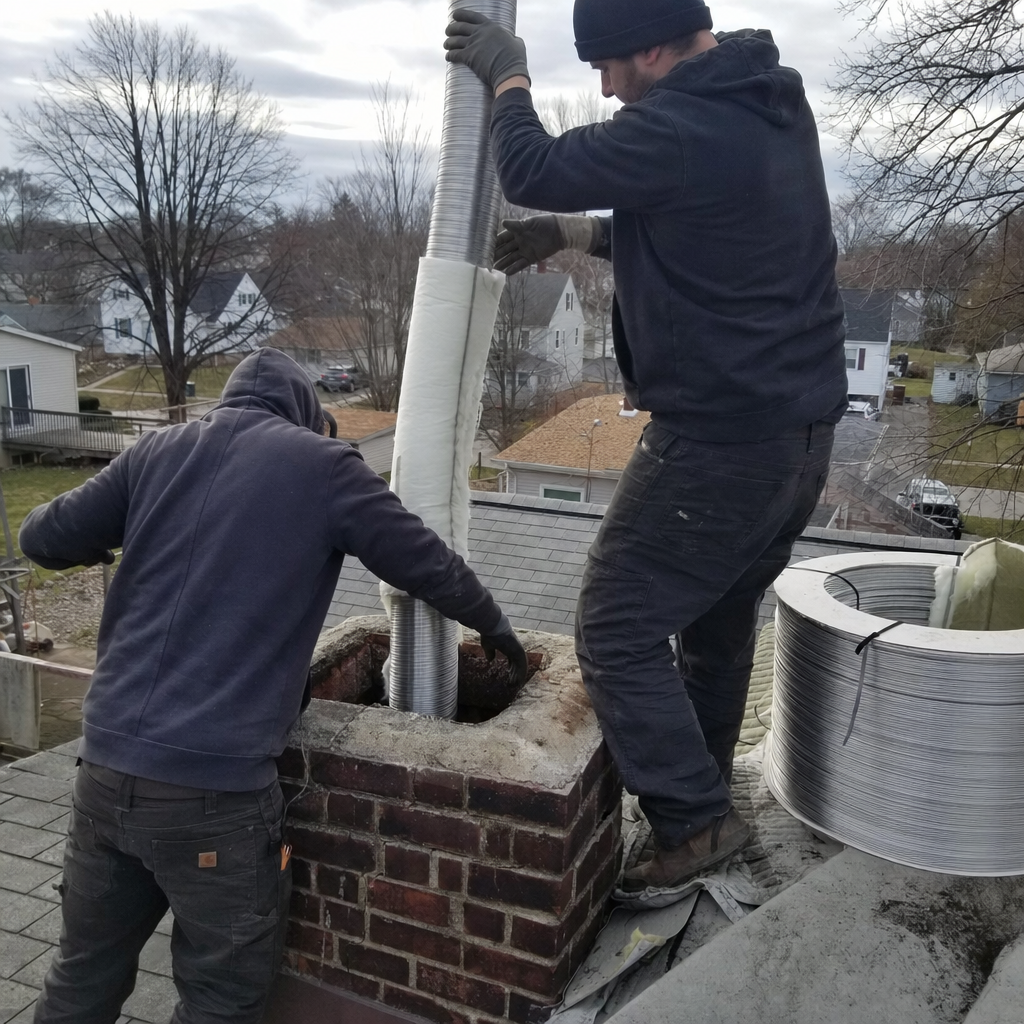
When we specify HeatShield for liner restoration, it’s because this cerfractory flue sealant is specifically formulated to withstand the thermal cycling that destroys lesser products in Rochester’s climate. DuraFlex stainless steel liners carry the engineering documentation for proper sizing and connection that generic alternatives lack. Olympia Chimney and Famco components fit precisely and carry manufacturer warranties that protect your investment.
We use these materials because 20 years of chimneys has shown us what fails — and when a liner pulls away from its top connection or a cap blows off in a February storm, the cost of material savings becomes catastrophic. Our fireplace services in Rochester include full specification documentation so homeowners understand exactly what was installed and why.
Ask any contractor: “What brand liner would you install, and why that specific product?” The answer reveals whether they’re sourcing from trade suppliers or picking up whatever’s available. Your chimney system deserves the same material specificity you’d demand for your roof, your windows, or your foundation.
Common Mistakes to Avoid
- Hiring based on price alone. The $79 Rochester chimney cleaning special is a loss-leader designed to create repair opportunities — often imaginary ones. Legitimate equipment, insurance, and training cost more than that covers.
- Assuming all “certifications” are equal. CSIA certification is the recognized standard. “Certified chimney professional” from an online course or manufacturer training weekend is not equivalent — verify through csia.org.
- Neglecting to confirm who’s actually arriving. The person you spoke with may be a salesperson, not your technician. In Rochester’s franchise-heavy market, this disconnect is common.
- Skipping the video inspection. Modern chimney diagnosis without camera documentation is incomplete. Any resistance to showing you footage suggests either inadequate equipment or something to hide.
- Ignoring seasonal timing. Rochester’s fall rush means less experienced technicians get pressed into service. Schedule inspections in spring or early summer for fuller attention and easier scheduling.
- Failing to verify insurance directly. Don’t accept “we’re fully insured” — request a certificate of insurance naming you as additional insured for the project duration.
- Treating chimney maintenance as optional. In Rochester’s heating-dependent climate, annual inspection isn’t a luxury — it’s what keeps combustion gases out of your living room.
When to Call a Professional
Call a qualified chimney contractor immediately if you notice: visible creosote flakes in your firebox, smoke backing up into rooms, a strong odor from your fireplace in warm weather, white efflorescence staining on exterior masonry, or any suspected chimney fire (rapid rumbling, dense smoke, intense heat). These symptoms indicate active hazards that DIY approaches cannot safely address.
Even without symptoms, NFPA 211 recommends annual inspection for all chimney systems — more frequently for heavy wood-burning use. In Rochester, where heating systems run hard from October through April, that annual cycle is essential, not conservative.
Premier Chimney Cleaning Greater Rochester offers free estimates throughout Rochester — call (888) 399-5696 to schedule with Anthony Perez directly. We’ll provide camera documentation, specific material specifications, and honest assessment of what your system needs versus what it doesn’t.
Frequently Asked Questions
A proper Level 1 chimney inspection and cleaning in Rochester typically costs $200–$300, while a Level 2 inspection with video documentation runs $300–$450. Prices below this range usually indicate uncertified operators, inadequate insurance, or equipment shortcuts that compromise safety. Call (888) 399-5696 for an exact quote — estimates are free.
Repair is usually more economical when damage is localized — cracked tiles in the upper section, for example — while full replacement becomes necessary with widespread deterioration, improper sizing, or combustible gas leakage throughout the system. We use HeatShield restoration for suitable candidates and DuraFlex stainless liners when replacement is indicated, always with camera verification of the completed work. Call (888) 399-5696 to discuss your specific situation.
Minor issues like cap replacement or basic masonry sealing can often be completed same-day, but liner work, crown rebuilding, or extensive masonry repair requires scheduled return visits with proper materials and curing time. We carry common components for Rochester-area systems, but won’t rush structural work that affects your safety. Call (888) 399-5696 to schedule — we’ll advise whether same-day service is appropriate for your needs.
Visit csia.org and use their “Find a Certified Professional” search tool — enter the individual’s name, not just the company name, as certification belongs to the person. The process takes under 30 seconds and confirms active credential status, which requires continuing education to maintain. Any hesitation to provide a full name for verification is a red flag.
Lake Ontario’s moisture, combined with 100+ annual freeze-thaw cycles and prevailing westerly winds, drives water into masonry systems and accelerates deterioration faster than in drier inland climates. We’ve documented severe spalling and liner damage in Rochester chimneys that appeared sound externally, particularly in historic neighborhoods with original construction. Annual camera inspection catches this hidden damage before it becomes a structural or safety issue.
A chimney sweep performs cleaning and basic Level 1 inspections, while a full-service chimney contractor handles cleaning, diagnosis, and all repairs including liner work, masonry rebuilds, and code compliance remediation. Many Rochester homeowners end up paying twice when a sweep discovers issues they can’t fix and refers out. Premier Chimney Cleaning handles the complete lifecycle — from annual chimney cleaning & sweep in Rochester through complete rebuilds — with Anthony Perez leading every phase.
The Bottom Line
Hiring a chimney contractor in Rochester comes down to four verifiable factors: CSIA certification that you confirm independently, owner-operated expertise that guarantees who’s on your roof, camera-documented inspection with specific findings you can see, and professional-grade materials with named specifications. The $79 special that skips any of these isn’t saving you money — it’s transferring risk to your family’s safety. In 20 years of chimneys, we’ve learned that the homeowners who ask hard questions upfront never regret it. The ones who prioritized convenience over qualification sometimes call us from emergency rooms or insurance adjusters’ offices.
Your chimney system deserves the same rigor you’d apply to hiring an electrician or a structural engineer. Ask the questions. Verify the credentials. Demand the documentation. And when you’re ready for an honest assessment from someone who’s spent two decades learning what Rochester chimneys need, we’re here.
Written by Anthony Perez, Owner & Lead Technician at Premier Chimney Cleaning Greater Rochester, serving Rochester since 2006.