
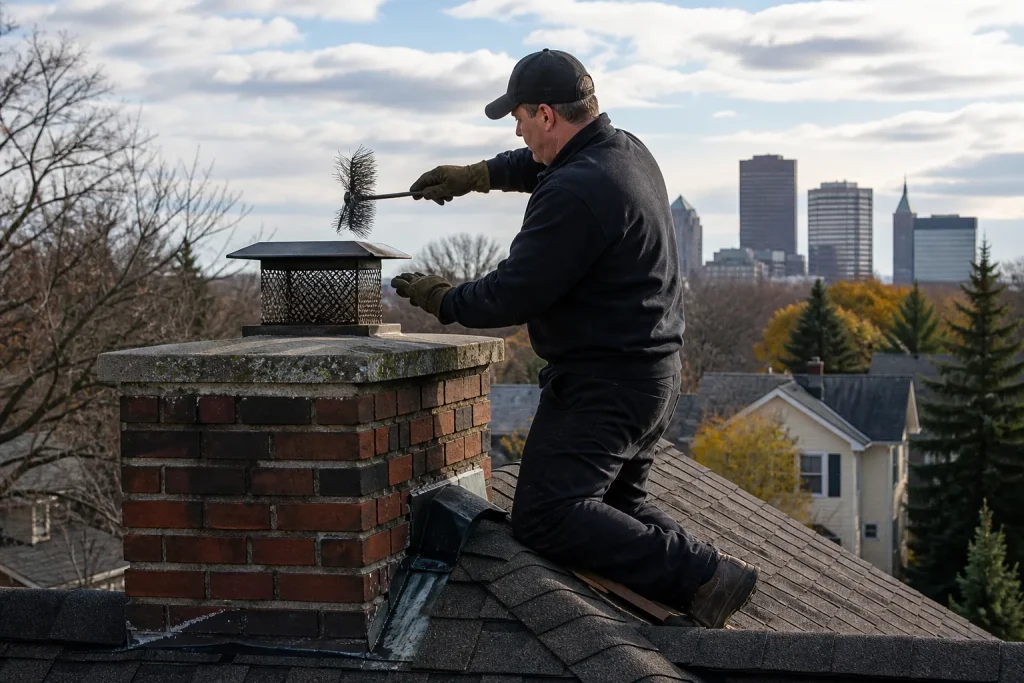
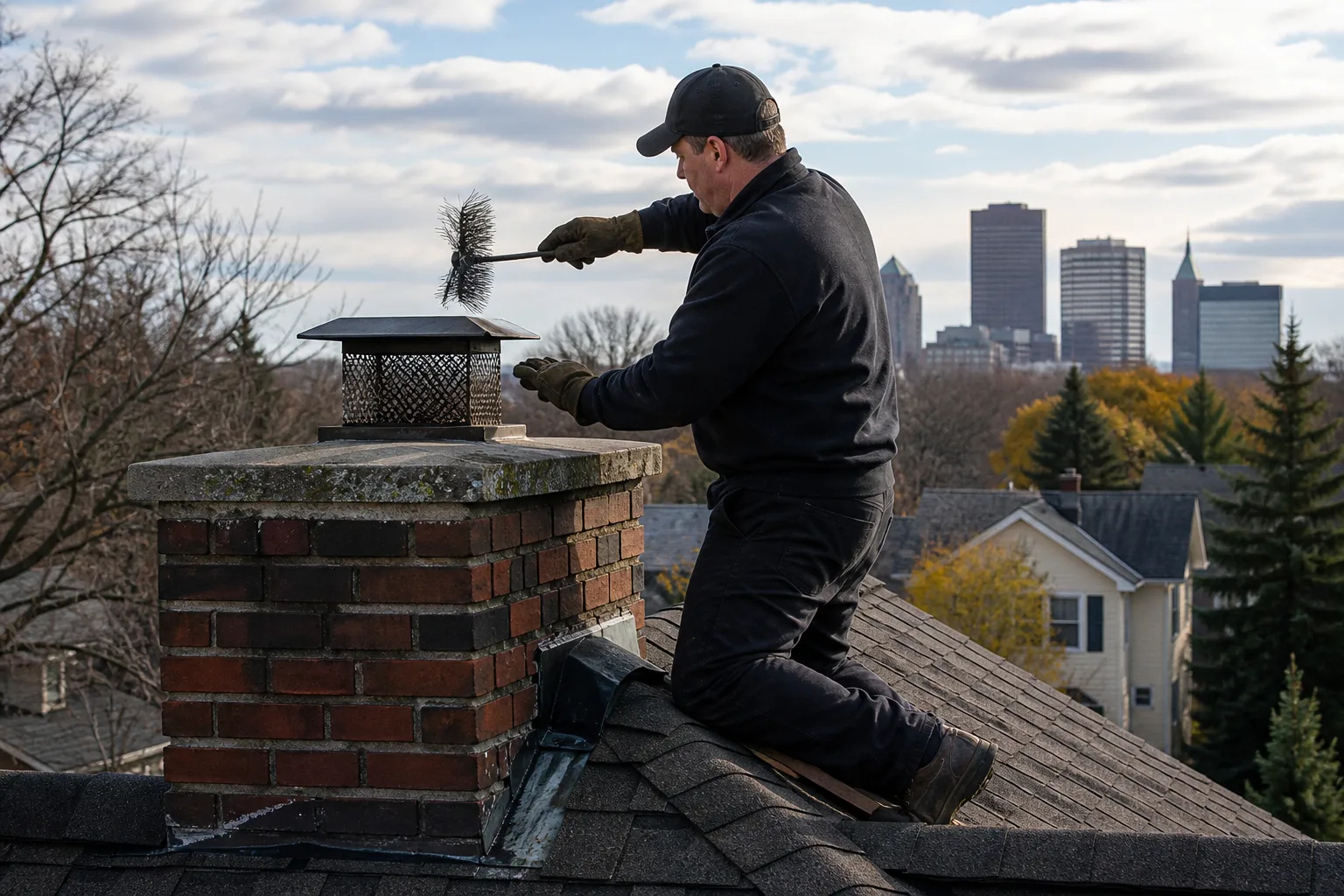
Gelco Chimney Cleaning & Sweep in Rochester: A Homeowner’s Guide
A Gelco chimney cap or top-mount damper in Rochester typically costs $180–$450 to service or replace, and annual cleaning should include specific inspection of the damper cable, silicone seal, and cap fit to prevent draft failure and water intrusion. If your Rochester home has a Gelco system and your sweep isn’t checking these three points, you’re not getting a complete service. For a proper inspection, call Premier Chimney Cleaning Greater Rochester at (888) 399-5696 — estimates are free.
Here’s the thing about Gelco products: they’re everywhere in Rochester, but they’re invisible until they fail. We’ve been sweeping chimneys across this city for 20 years, and we’ve lost count of how many times we’ve found a Gelco top-mount damper left jammed open by a previous technician who didn’t recognize the mechanism, or a cap installed with the wrong base dimension letting Lake Ontario runoff straight into the flue. These aren’t generic parts. They have specific operating tolerances, and when they’re ignored, your chimney doesn’t draft properly, your heating bills climb, and you’re looking at moisture damage that could’ve been prevented.
What Gelco Makes and Where You’ll Find It in Rochester
Gelco specializes in two product lines that matter for Rochester homeowners: chimney caps and top-mount dampers. Their caps are galvanized or stainless steel with welded seams and specific base widths designed to overhang tile flues common in 1950s–1980s Rochester construction. The top-mount dampers — Gelco’s better-known product — replace traditional throat dampers entirely, sitting at the chimney crown instead of above the firebox.
In Rochester, we see Gelco dampers most often in:
- Colonial and Cape Cod homes in Brighton and Irondequoit, where original throat dampers rusted out and Gelco retrofits became the standard fix in the 1990s and 2000s
- Greek Revival and Victorian properties in the Park Avenue and Corn Hill neighborhoods, where chimney height and draft dynamics make top-mount dampers more effective
- Split-levels in Greece and Gates-Chili, where the original builder installed Gelco caps as part of package masonry work
Unlike commodity caps you’ll find at big-box stores, Gelco products are spec’d by chimney professionals for specific flue dimensions and draft requirements. We’ve replaced too many “universal” caps that a homeowner or handyman forced onto a Gelco-sized flue, only to have it blow off in a Rochester winter storm or create a gap that funnels meltwater down the chimney face.
How Gelco Top-Mount Dampers Work — and Why Your Sweep Needs to Know
A Gelco top-mount damper operates on a cable system that runs down the flue to a handle mounted in the firebox. When you pull the handle, the damper plate at the chimney top pivots open against a silicone seal. Close it, and the seal compresses, creating an airtight barrier.
This is fundamentally different from a traditional throat damper, which is a cast-iron plate above the firebox that you operate with a lever or rotary control. The throat damper seals at the bottom of the flue; the Gelco seals at the top. That top seal is what makes Gelco dampers effective for energy efficiency — you’re not heating 20 feet of chimney column all winter — but it’s also what creates specific service requirements.
Here’s what a sweep who knows Gelco will do differently:
- Check cable tension and routing. The stainless cable runs through a conduit in the flue. If it’s kinked, frayed, or binding, the damper won’t seal fully. We’ve found cables in Rochester homes that were partially seized from creosote buildup — the previous sweep never tested full range of motion.
- Inspect the silicone seal for hardening or compression set. Rochester’s freeze-thaw cycles are hard on rubber compounds. A seal that was supple in October can be rigid and leaking by March.
- Verify full closure and measure draft with the damper open. A Gelco damper plate that doesn’t seat squarely — often from ice loading or animal impact — creates a gap that looks closed from below but isn’t.
- Clean around, not through, the damper mechanism. The cable and pivot assembly can trap creosote and debris. Blind brushing can force material into the pivot housing.
Last season, we serviced a Gelco damper in a Webster colonial where the cable had been left with about three inches of slack by a previous contractor. The homeowner thought it was closing fully; it was actually leaving a half-inch gap that let conditioned air escape all winter. That’s not a minor inefficiency — that’s real money on a Rochester heating bill.
Common Gelco Failures in Rochester’s Climate
Rochester’s weather pattern — heavy lake-effect snow, repeated freeze-thaw, humid summers — creates specific failure modes for Gelco components that don’t show up in drier or more stable climates.
Cable wear and freeze seizure: The stainless cable is corrosion-resistant, not corrosion-proof. Moisture enters the conduit, freezes, and expands. We’ve extracted cables in January that were locked solid, the homeowner unaware because they’d stopped using the fireplace and never checked. In our experience, cables older than 12–15 years in Rochester exposure are living on borrowed time.
Seal deterioration: Gelco uses a silicone-rubber gasket that compresses against the damper plate. UV exposure at the chimney top, combined with thermal cycling, causes this to harden and lose resiliency. A hardened seal doesn’t just leak air — it can crack, letting water track down the flue wall. We’ve pulled dampers in Pittsford where the seal had degraded to the point of crumbling, with accompanying spalling on the flue tiles below.
Freeze-related closure failure: The damper plate pivots on a stainless axle with bronze bushings. Water intrusion into the pivot housing freezes, expanding the bushing clearance. Result: the plate closes partially, or closes fully but doesn’t seal because it’s canted. This is the failure that homeowners miss most often — it looks closed from the firebox, but a smoke test or draft gauge reveals the leak.
Cap wind damage and fastener fatigue: Gelco caps use specific base brackets and tension screws. Rochester’s wind exposure, especially on homes near Lake Ontario or on elevated lots in Perinton, can work these fasteners loose. A cap that shifts even slightly can direct water into the flue or, in extreme cases, detach entirely.
How Gelco Changes Your Cleaning and Maintenance Routine
If you have a Gelco top-mount damper, your annual sweep isn’t just “brush the flue and call it done.” The damper is an active mechanical system that needs functional verification every season.
Here’s our standard Gelco service protocol at Premier Chimney Cleaning Greater Rochester:
- Operate the damper through full open/close cycle before any cleaning begins — if it’s seized, we need to address that first
- Visual inspection of cable, handle, and pivot from top and bottom
- Seal condition check: pliability test, visual for cracking or compression set
- Damper plate seating verification — we use a flashlight and mirror from below, and visual from above
- Clean flue with damper open, then clean damper housing and pivot area with specialized tools (not a standard brush)
- Lubricate pivot per Gelco specification — we use Copperfield’s high-temp silicone lubricant, never petroleum-based products that gum up in cold
- Final operation test and draft measurement with a manometer
A sweep who treats your Gelco damper as just another flue cap is missing half the system. We’ve inherited service records from Rochester homeowners where three consecutive “annual sweeps” never included a damper function test — the cable was slowly corroding, the seal was hardening, and nobody caught it until the homeowner noticed a smell of creosote in the house on a windy day.
When to Replace vs. Adjust — and Why Fit Matters
Not every Gelco problem needs replacement. A binding cable often just needs cleaning and re-routing. A slightly compressed seal can sometimes be restored to function if caught early. But there are clear replacement thresholds:
Replace the damper assembly when: Cable is frayed or corroded through; seal is cracked, missing chunks, or hardened beyond recovery; pivot axle is worn or bushing is egged out; damper plate is warped or cracked from thermal shock or impact.
Replace the cap when: Base is rusted through at the flue interface; mesh is torn or detached (squirrel damage is common in Rochester’s tree-heavy neighborhoods); tension screws are stripped or brackets are fatigued.
Here’s where compatibility becomes critical: Gelco dampers are sized to flue dimensions and chimney crown configuration. A “close enough” fit from another manufacturer — or a generic universal damper — won’t seat properly, won’t draft correctly, and often won’t survive Rochester’s weather. We’ve removed improperly spec’d replacements from Olympia Chimney and other brands where the mounting flange didn’t match the crown slope, creating a gap that funneled water straight to the flue liner.
When we spec a replacement, we measure flue ID, crown dimensions, and existing anchor points. For liner restorations paired with Gelco damper replacement, we often use DuraFlex or HeatShield systems — but the damper itself needs to interface cleanly with whatever liner or flue is present. This is pattern recognition from 20 years of chimneys, not something you get from a catalog.
When to Call a Pro in Rochester
If your Gelco damper handle feels different than last season — tighter, looser, gritty, or with a new catch in the motion — that’s your warning. If you can see daylight around the damper plate when it’s supposedly closed, or if you feel a draft when the fireplace isn’t in use, you have a seal failure. If your cap is visibly shifted, rattling, or missing fasteners, don’t wait for the next storm.
Related services in Rochester: Chimney Repair in Rochester | Fireplace Services in Rochester
The Bottom Line
Gelco chimney caps and dampers are solid, well-engineered products — but they’re not set-and-forget hardware. Rochester’s climate demands annual inspection of the cable, seal, and cap integrity, and the specific design of Gelco top-mount dampers requires a sweep who understands the mechanism, not just the flue.
Key takeaways:
- Gelco top-mount dampers seal at the chimney top, not the throat — this changes how they fail and how they’re serviced
- Rochester’s freeze-thaw cycles and lake-effect moisture create specific cable, seal, and pivot failures that annual inspection should catch
- A proper Gelco service includes functional testing, seal inspection, and pivot maintenance — not just flue brushing
- Replacement requires exact fit to flue and crown dimensions; “universal” alternatives often create new problems
If you’re in Rochester and aren’t sure whether your last sweep actually checked your Gelco damper, or if you’re seeing signs of failure, Premier Chimney Cleaning Greater Rochester offers free estimates — call (888) 399-5696. Anthony shows up on your job, and we’ll tell you straight what’s needed, what can wait, and what you can handle yourself.
Frequently Asked Questions
Annual cleaning and inspection of a Gelco system in Rochester typically runs $180–$280, while cap or damper replacement ranges from $280–$450 depending on flue size and access. If the damper cable or pivot needs repair without full replacement, you’re usually in the lower half of that range. Call (888) 399-5696 for an exact quote — estimates are free.
You can brush the accessible flue area from below with proper rods and brushes, but the damper mechanism itself — cable routing, pivot lubrication, seal inspection, and draft verification — requires roof access and specific knowledge of Gelco’s assembly. We’ve seen homeowners in Rochester strip pivot screws or force cables out of alignment attempting DIY service. For safety and warranty preservation, have a professional handle the mechanical components.
With proper annual service, 15–20 years is typical in Rochester. Without maintenance, we’ve seen cables seize in 8–10 years and seals fail in 6–8 years due to freeze-thaw exposure. The difference is almost always whether someone inspected and lubricated the system yearly — not just brushed past it.
For many Rochester homes, yes — especially if the original throat damper was rusted or damaged, or if energy efficiency is a priority. A Gelco top-mount damper seals the entire flue column, eliminating the heat loss of a throat damper that leaves 15–25 feet of chimney as a thermal chimney even when “closed.” However, if your flue is unlined or severely deteriorated, the damper type is secondary to addressing liner condition first. We assess this on every Chimney Cleaning & Sweep in Rochester visit.
Written by Anthony Perez, Owner & Lead Technician at Premier Chimney Cleaning Greater Rochester, serving Rochester since 2006.
Need Chimney Cleaning Help?
Call Premier Chimney Cleaning Greater Rochester — licensed & insured, available 24/7 in Rochester.
(888) 399-5696