
Last updated July 12, 2026
The Complete Guide to Chimney Cleaning in Rochester
Most chimney fires don’t start during a roaring blaze — they ignite from a slow burn in creosote that built up during last February’s cold snap when you ran the fireplace around the clock for a week straight. In Rochester, where heating season stretches from October through April and temperatures routinely plunge below 10°F, your chimney works harder and longer than chimneys in milder climates. After 20 years of looking inside Rochester chimneys, we’ve learned that generic “sweep before winter” advice misses the real story of what local conditions do to fireplace systems. This guide covers what Rochester homeowners actually need to know: how our freeze-thaw cycle destroys mortar, why our long burning season creates dangerous creosote stages that shorter seasons don’t, and how to read a sweep report without getting oversold on repairs you don’t need.
Quick Answer
Chimney cleaning in Rochester, NY typically costs $200–$350 for a standard Level 1 sweep with inspection, and should be performed annually for wood-burning systems or every 1–2 years for gas. Because Rochester’s heating season runs 6–7 months and our freeze-thaw cycle accelerates masonry deterioration, local homeowners benefit from scheduling sweeps in late spring — after heavy use, before summer humidity sets in — rather than waiting until fall like national guides suggest.
Table of Contents
- How Rochester’s Climate Destroys Chimneys Faster Than National Averages
- The Three Types of Creosote and Why Rochester Burners Hit Stage 2 or 3
- Level 1 vs. Level 2 Inspection: What Rochester Homeowners Actually Need
- When to Schedule: Why Rochester’s Sweep Season Runs Different
- What Happens During a Professional Chimney Cleaning
- How to Read a Sweep Report Without Getting Oversold
- Rochester Chimney Cleaning Cost Breakdown
- Common Mistakes to Avoid
- When to Call a Professional
- Frequently Asked Questions
How Rochester’s Climate Destroys Chimneys Faster Than National Averages
Rochester averages 130+ freeze-thaw days annually — days where temperatures swing above and below 32°F. Every cycle forces moisture in your masonry to expand when it freezes and contract when it thaws. Over a single Rochester winter, that’s 130+ mini-earthquakes happening inside your chimney’s brick and mortar.
National chimney maintenance guides written for temperate climates don’t account for this. A chimney in Charlotte or San Diego might see 20 freeze-thaw cycles in a bad year. In Rochester’s Park Avenue or Corn Hill neighborhoods, where century-old brick chimneys are common, that accelerated cycling creates specific failure patterns we’ve documented across two decades:
- Spalling brick: Water enters tiny cracks, freezes overnight, and pops off brick faces by spring. We’ve replaced entire chimney crowns in Southeast Rochester homes where spalling went unaddressed for two seasons.
- Deteriorated mortar joints: Repointing that might last 25 years in milder climates needs attention in 12–15 years here. In Lake Ontario-effect snow belts like Greece and Webster, we’ve seen mortar fail even faster.
- Flue liner cracking: Thermal shock from rapid temperature swings — a cold chimney hit with 500°F exhaust — combines with freeze-thaw stress to crack clay tile liners. A cracked liner is a carbon monoxide pathway into your living space.
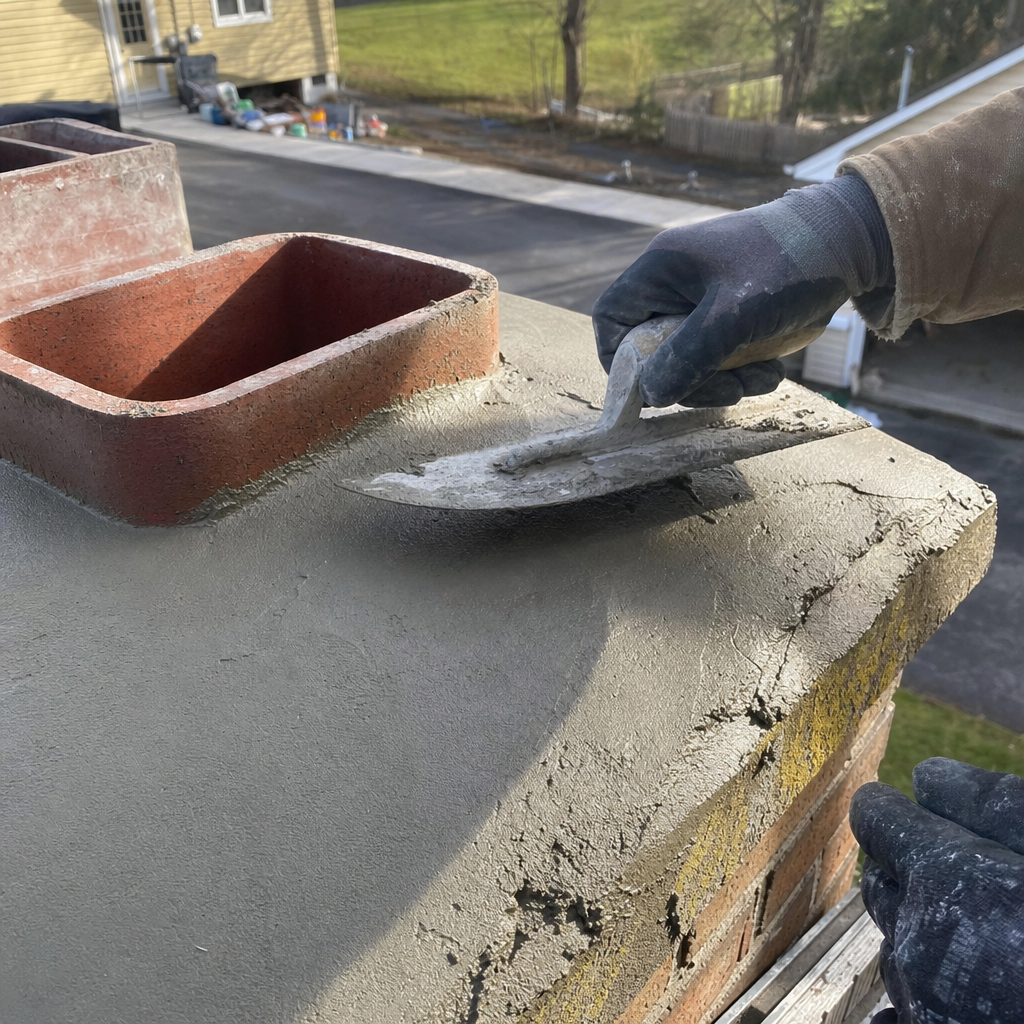
- Crown failure: The concrete cap at your chimney top takes the worst weather. Rochester’s freeze-thaw cycle plus lake-effect snow load causes crowns to crack and slope inward, funneling water directly into the flue.
Here’s what this means for cleaning frequency: a deteriorating chimney isn’t just a repair issue — it’s a safety issue. Cracked mortar and spalling brick create additional nooks where creosote accumulates, and compromised liners allow combustion gases to escape. In our experience, Rochester chimneys showing early masonry deterioration need more frequent inspection, not just the standard annual sweep.
We use Copperfield professional-grade crown sealants and repair compounds specifically because they’re formulated for severe weather zones. Big-box sealants rated for “all climates” don’t hold up to Rochester’s cycle count — we’ve removed and replaced too many failed DIY applications to count.
The Three Types of Creosote and Why Rochester Burners Hit Stage 2 or 3
Creosote isn’t one substance — it’s a progression. Understanding the stages explains why Rochester’s extended burning season creates hazards that casual burners in shorter-season climates rarely face.
Stage 1: Sooty Creosote
Soft, flaky, black or brown. Brushes off easily. This is what you want to find — it means you’re burning seasoned hardwood, maintaining hot fires, and sweeping regularly. In Rochester, we see Stage 1 in chimneys swept annually that burn 2–3 times weekly.
Stage 2: Tar-Glaze Creosote
Shiny, hard, black flakes that look like tar. Requires stiff poly or chain whips to remove, not standard brushes. Stage 2 forms when fires smolder — damp wood, restricted airflow, or shutting down the damper too early. Here’s the Rochester-specific factor: during January cold snaps when temperatures hit -10°F, homeowners naturally damp down fires to burn overnight. That smoldering mode, repeated for weeks, pushes Stage 1 into Stage 2. We’ve pulled pounds of Stage 2 from chimneys in Brighton and Irondequoit where owners burned responsibly but didn’t realize how cold-weather burning patterns changed their creosote accumulation.
Stage 3: Hardened Glaze Creosote
Shiny, rock-hard, nearly impossible to remove without chemical treatment or rotary equipment. Stage 3 is a chimney fire waiting to happen — it ignites at lower temperatures and burns with explosive force. In 20 years, we’ve encountered Stage 3 most often in two Rochester scenarios: rental properties where tenants ignored maintenance, and primary residences where owners switched to wood heat for cost savings during the 2022–2023 energy price spike without understanding the maintenance burden.
The removal reality: Stage 1 takes 45 minutes. Stage 2 requires specialized equipment and adds 30–60 minutes. Stage 3 often needs chemical treatment (we apply Olympia Chimney professional creosote modifiers) followed by a return visit — it’s not a same-day fix, and any sweep who claims otherwise is risking your safety or damaging your flue.
Level 1 vs. Level 2 Inspection: What Rochester Homeowners Actually Need
The National Fire Protection Association (NFPA) defines three inspection levels, but most Rochester homeowners only encounter Levels 1 and 2. Here’s what they actually mean in practice — not the textbook definition.
Level 1 Inspection
A visual examination of readily accessible portions of the chimney exterior, interior, and appliance connection. No tools required to open or dismantle anything. The sweep looks for obstructions, creosote buildup, and basic structural soundness.
When you need it: Annual maintenance on a system you’ve been using without changes. This covers most Rochester homeowners with established fireplace routines.
Level 2 Inspection
Everything in Level 1, plus examination of attics, crawl spaces, and basements; video scanning of the flue interior; and inspection of chimney clearances to combustibles. Requires specialized camera equipment.
When Rochester homeowners specifically need the upgrade:
- You’re buying a home. In Rochester’s older housing stock — Park Avenue, South Wedge, 19th Ward — a Level 2 reveals liner conditions hidden behind finished basements or attic insulation. We’ve found failed liners in “recently inspected” homes where the generalist home inspector never looked up the flue.
- You’ve had a chimney fire. Even a “small” fire cracks liners and damages mortar. The exterior can look fine while the interior is compromised. We require Level 2 after any fire event — it’s non-negotiable for safety.
- You’re changing appliances. Converting from wood to gas insert? Installing a pellet stove? Rochester’s older chimneys often need liner resizing for new appliance categories. A Level 2 documents what you’ve actually got before the appliance installer discovers a mismatch.
- Significant weather event. After the 2019 Halloween storm that dropped 8+ inches of heavy snow across Monroe County, we performed dozens of Level 2 inspections finding cracked crowns and shifted flue tiles from freeze-sudden-thaw cycling.
- 20+ year old chimney with no documented inspection history. Common in inherited properties or long-term rentals in neighborhoods like Charlotte or Edgerton.
Red flag: A sweep pushing Level 2 on every annual customer is upselling. A sweep never mentioning Level 2 when you’re buying a 1920s Rochester colonial is negligent. The distinction matters.
When to Schedule: Why Rochester’s Sweep Season Runs Different
National advice says “sweep before winter.” In Rochester, that’s backwards for two reasons.
First: Our burning season runs October through April, often into May during cold springs. Sweeping in September means your chimney is clean for the first fire — and accumulating creosote for seven months straight with no mid-season inspection. By March, you’ve got a full season’s buildup during the coldest, highest-use period.
Second: Rochester’s summer humidity interacts with residual soot. A chimney swept in September and left dormant until October absorbs moisture that combines with acidic combustion residues, accelerating mortar and metal component deterioration. We’ve opened “clean” chimneys in October that smelled like a chemistry set from summer humidity activating leftover deposits.
The Rochester schedule we recommend after 20 years:
- Late April to early June: Primary sweep window. Heavy use season just ended. Humidity hasn’t peaked. You address any winter damage before it worsens through summer. Scheduling is easier — we’re not slammed with panicked October callers.
- September touch-up: For heavy burners (daily wood heat in rural Webster, Penfield, or Henrietta properties), a quick inspection and light sweep clears any summer debris or animal nesting before lighting the first fire.
- Emergency mid-winter: If you notice performance changes — smoking back into the room, unusual odors, visible creosote flakes in the firebox — don’t wait. A blocked or deteriorating chimney in January is an immediate hazard.
Our Chimney Cleaning & Sweep in Rochester calendar fills fastest in October because that’s when national advice kicks in. Smart Rochester homeowners beat the rush.
What Happens During a Professional Chimney Cleaning
Knowing what legitimate work looks like helps you spot shortcuts. Here’s our standard process — the minimum any Rochester homeowner should expect.
Pre-work (10–15 minutes)
We lay protective floor coverings from the work area to the door, inspect the firebox and damper for visible damage, and set up HEPA filtration vacuum equipment. Anthony Perez checks the roofline from ground level for crown or cap damage we need to address. If we’re accessing the roof, we verify conditions are safe — Rochester’s December ice is no place for rushed ladder work.
Flue cleaning (30–90 minutes depending on creosote stage)
Up on the roof, we remove the chimney cap and inspect the flue opening with a high-powered flashlight. We select brush heads based on flue diameter and creosote type — poly brushes for Stage 1, chain whips for Stage 2, rotary systems with DuraFlex equipment for stubborn buildup. Brushing runs from the top down, with vacuum suction at the bottom to capture debris.
For Rochester’s common unlined or clay-tile-lined chimneys in pre-1970s housing, we’re especially careful with brush pressure. Old terra cotta tiles fracture under aggressive brushing — we’ve rescued too many DIY cleaning attempts that cracked flue liners.
Firebox and smoke chamber cleaning
We remove ash and debris, hand-clean the smoke chamber (the area above the damper that funnels smoke into the flue), and inspect the firebrick for spalling or mortar loss. In Rochester, where many homeowners burn 24/7 during cold snaps, the smoke chamber often shows more deterioration than the flue itself.
Final inspection and documentation
We perform the Level 1 inspection, document findings with photos, and provide a written report. If we find conditions requiring Chimney Repair in Rochester, we explain exactly what we found, why it matters for safety, and priority level — never a pressure sale.
How to Read a Sweep Report Without Getting Oversold
A sweep report is where trust gets tested. After 20 years and nearly 700 customer reviews, we’ve learned that transparent reporting builds long-term relationships; inflated findings destroy them. Here’s how to evaluate what you’re handed.
Routine findings — no immediate action needed:
- Light soot accumulation (Stage 1) with normal brushing removal
- Minor exterior staining or efflorescence (white powder on brick) — cosmetic, monitor annually
- Slightly weathered mortar joints with no missing material — note for future repointing
- Standard wear on firebrick — expected after years of use
Findings requiring attention within the season:
- Stage 2 or 3 creosote — schedule removal before next burning period
- Cracked or missing chimney cap — water entry accelerates all deterioration
- Damaged or missing spark arrestor — fire hazard, especially with nearby trees
- Deteriorated crown with visible cracking — water infiltration point
Immediate safety concerns — burning should pause:
- Cracked or displaced flue liner — carbon monoxide and fire risk
- Significant mortar loss exposing chimney interior — structural and fire risk
- Obstruction (animal nest, collapsed debris) — smoke and CO backup
- Chimney fire evidence (spalled flue tiles, distorted metal) — liner integrity compromised
Oversell red flags to question:
- “Your chimney is unlined and dangerous” — many Rochester chimneys built before 1940 were constructed without liners and functioned safely for decades. Unlined doesn’t automatically mean unsafe; it means evaluation against current standards. We specify when lining is actually required versus recommended.
- “You need a stainless steel liner” without explaining why — clay tile liners in good condition don’t need replacement. We only recommend Famco or DuraFlex stainless systems when existing liners are damaged, when converting appliance types, or when NFPA clearance requirements can’t be met otherwise.
- Vague “recommend annual Level 2 inspections” without specific justification — see our Level 1 vs. Level 2 section above.
Our reports include photos of every finding with clear labels. If you don’t understand something, ask. Anthony Perez explains every finding on-site — there’s no rotating crew member reading from a script.
Rochester Chimney Cleaning Cost Breakdown
Prices vary by creosote stage, accessibility, and inspection level. Here’s what Rochester homeowners should expect based on our 20 years of local pricing:
| Service | Typical Range | What Affects Price |
|---|---|---|
| Level 1 sweep + inspection (Stage 1 creosote) | $200–$280 | Standard access, routine maintenance |
| Level 1 sweep + inspection (Stage 2 creosote) | $280–$350 | Specialized equipment, additional time |
| Stage 3 creosote treatment | $350–$500+ | Chemical application, return visit required |
| Level 2 inspection (video scan) | $250–$400 | Camera equipment, attic/crawlspace access |
| Chimney cap replacement | $350–$800 | Material (galvanized vs. stainless vs. copper), size |
| Crown repair/sealing | $300–$600 | Extent of cracking, material needed |
| Fireplace Services in Rochester (damper repair, firebox rebuild) | $400–$1,500+ | Component type, masonry extent |
We provide upfront pricing before beginning work — no surprises after we’re on your roof. Estimates for repair work are free.
Price context: Rochester’s chimney cleaning market runs slightly below national averages because our cost of living is moderate, but beware pricing that seems too low. Cut-rate sweeps often skip roof access (cleaning from the bottom only, missing crown damage), use improper equipment that damages liners, or lack proper insurance. We’ve been called to fix damage from $99 “specials” that omitted critical inspection steps.
Common Mistakes to Avoid
- Sweeping only in October because “that’s when you do it.” In Rochester, this leaves you with a full winter’s accumulation and no mid-season check. Late spring sweeping catches winter damage early and beats the fall rush.
- Burning unseasoned wood from the Finger Lakes or local tree services. Wood needs 12+ months of drying in Rochester’s humid summers. We can identify unseasoned wood by the thick, wet creosote it produces — it’s the fastest path to Stage 3 buildup.
- Assuming gas fireplaces need no maintenance. Gas systems don’t produce creosote, but they accumulate debris, suffer from deteriorated log sets, and can develop venting problems. Annual inspection still matters — carbon monoxide doesn’t discriminate by fuel type.
- Ignoring “minor” crown cracks. In Rochester’s freeze-thaw environment, a hairline crack in October becomes a water infiltration highway by March. Crown sealing costs $300–$600; crown rebuilds run $1,500+.
- Hiring based on coupon price without verifying credentials. New York does not require chimney-specific licensing — anyone can buy brushes and call themselves a sweep. Verify insurance, check review volume and recency (our 708 reviews span years of consistent service), and ask who actually performs the work.
- DIY cleaning without understanding your system. We’ve replaced flue tiles cracked by homeowners using the wrong brush size, and we’ve found nests pushed deeper into flues by well-meaning attempts. For standard maintenance, professional equipment and trained eyes matter. For liner work or roof access, the safety risks are serious — falls from Rochester’s icy roofs are genuine hazards.
When to Call a Professional
Call for immediate inspection if you notice smoke backing into the room, a strong tar odor when the fireplace isn’t in use, visible cracks in the firebox, or debris falling into the fireplace. These indicate active problems that worsen with each use. For routine maintenance, schedule before your burning season begins — but in Rochester, consider our late-spring timing for optimal results.
Premier Chimney Cleaning Greater Rochester home offers free estimates throughout Rochester and surrounding Monroe County communities. Anthony Perez personally evaluates every project. Call (888) 399-5696 to schedule — mention this guide and we’ll include a complimentary crown condition assessment with your standard sweep.
Frequently Asked Questions
Standard chimney cleaning in Rochester ranges from $200–$350 depending on creosote buildup stage and accessibility. Stage 1 (light soot) falls at the lower end; Stage 2 or 3 (hardened creosote) requires specialized equipment and additional time. Call (888) 399-5696 for a free exact quote — estimates are free and we provide upfront pricing before any work begins.
Wood-burning systems in Rochester need annual sweeping due to our extended 6–7 month heating season. Gas systems should be inspected annually and cleaned every 1–2 years depending on use. Homes in lake-effect snow belts like Greece or Webster, or properties burning daily through winter, may benefit from mid-season inspection. Call us to discuss your specific burning pattern.
You can perform basic firebox cleaning and ash removal, but professional flue cleaning requires proper equipment and trained assessment of liner condition. Rochester’s older housing stock often contains fragile clay tile liners that crack under improper brushing. Additionally, roof access during our icy winters presents genuine fall hazards. We recommend professional service for complete safety verification.
Late April through early June is optimal for Rochester homeowners. You’ve just completed heavy use season, summer humidity hasn’t peaked, and scheduling is easier than the October rush. For heavy burners, a September touch-up inspection before lighting the first fire provides additional security.
Cracked or displaced flue tiles, visible gaps between tiles, or a Level 2 video scan showing deterioration indicate replacement needs. In Rochester’s freeze-thaw climate, liner damage accelerates once started. We use DuraFlex and Famco stainless steel systems when replacement is genuinely needed — not as a default upsell. A proper evaluation distinguishes between monitoring and mandatory replacement.
Minor cracks caught early can be sealed for $300–$600, preserving the existing crown. Once cracking progresses to spalling or structural separation, full replacement at $1,500+ becomes necessary. In Rochester’s climate, delaying crown repair guarantees worsening damage through freeze-thaw cycling. We assess crown condition during every sweep and recommend action thresholds honestly.
The Bottom Line
Rochester’s unique climate demands chimney maintenance that generic advice doesn’t address. Our 130+ annual freeze-thaw cycles, extended burning season, and lake-effect weather create deterioration patterns requiring local expertise to identify and manage. Annual professional sweeping — ideally timed in late spring — catches creosote buildup before it reaches dangerous stages and identifies masonry damage before water infiltration compounds the problem. The key is finding a specialist who understands these local conditions, provides transparent reporting, and doesn’t use scare tactics to sell unnecessary work. Nearly 700 homeowners have trusted our approach; the pattern recognition from 20 years of Rochester chimneys makes the difference between maintenance that preserves your system and repairs that could have been prevented.
Written by Anthony Perez, Owner & Lead Technician at Premier Chimney Cleaning Greater Rochester, serving Rochester since 2006.