
Chimney Liner Installation Cost in Rochester, NY: What You’ll Actually Pay in 2024
In Rochester, chimney liner installation typically runs between $2,800 and $5,500 for a standard flexible stainless steel relining, while HeatShield ceramic resurfacing falls in the $1,800–$3,200 range for chimneys with salvageable clay tile. Most jobs in the South Wedge, 19th Ward, and Corn Hill areas fall on the higher end because the pre-1930s brick flues we’re working with were never built to modern standards — and often weren’t corrected when furnaces switched to gas. Call (888) 399-5696 for a free inspection and exact quote; we carry DuraFlex, HeatShield, and Olympia Chimney materials on every truck.
Here’s the thing about Rochester that national cost guides don’t capture: we have a liner problem rooted in housing stock that predates liner standards entirely. Walk through Maplewood or Swillburg and you’ll find thousands of two-family homes built in the 1910s and 1920s with a single brick chimney stack that originally served a coal furnace in the basement and maybe a fireplace upstairs. When those coal burners got swapped for gas equipment in the 70s and 80s — and it happened by the block — nobody relined the flue. The oversized, unlined brick passage meant for coal exhaust got repurposed for acidic, moisture-laden gas flue gases. Anthony Perez, our owner and lead technician, still finds active gas appliances venting into bare brick flues with gaps you can see through to the attic. That’s not a code technicality. That’s a carbon monoxide path into your living space, and it’s why we treat liner assessment as safety-first work, not an upsell conversation.
Why Rochester’s Housing Stock Makes Liner Installation Different
The established neighborhoods we work in — South Wedge, 19th Ward, Corn Hill, Maplewood, Swillburg — are dense with late-1800s to early-1930s brick construction. The majority of these chimneys feature original unlined masonry or single-wythe brick flues built before clay tile liner standards were commonplace. Many were later converted to serve gas furnaces or retrofitted with wood stoves without proper relining. This isn’t a historical footnote; it’s a recurring code and safety issue Rochester chimney techs encounter constantly.
What happens when you vent a modern gas appliance into a coal-era flue? Three problems, all of them expensive if ignored:
- Condensation damage: Gas flue gases are cooler and wetter than coal exhaust. An oversized flue slows draft, lets water vapor condense on brick walls, and saturates the masonry from inside.
- Acidic deterioration: That condensation carries chlorides and sulfur compounds that eat mortar joints. We’ve opened flues in Corn Hill where the brick faces have spalled half an inch from decades of internal acid exposure.
- Carbon monoxide infiltration: Open mortar joints, missing brick, and gaps where the flue passes through floor structures become pathways for CO into occupied space. Anthony’s found this in attics, in wall cavities, and — worst case — backing into the living room through a fireplace opening with a failed damper.
Lake Ontario’s moderating effect keeps Rochester temperatures oscillating near freezing for weeks at a time, producing an unusually high annual count of freeze-thaw cycles. The wet, heavy character of our lake-effect snow — distinct from drier inland snow — holds moisture against masonry long after storms end. This compounds every liner failure because water that’s already infiltrated through cracked crowns or failed flashing freezes, expands, and opens new pathways for exhaust gases. Every chimney we inspect in Rochester gets evaluated as a system: crown, flashing, mortar, and liner integrity together.
Your Two Main Liner Options: What Premier Installs and What Each Costs
We’re not here to sell you a new liner — we’re here to tell you what’s actually going on up there. Anthony’s 20 years of chimneys means he can assess at inspection whether a flue needs full relining, HeatShield resurfacing, or neither. Homeowners get an accurate scope, not an automatic upcharge. Here are the two solutions we install, with realistic Rochester pricing based on the condition of pre-1930s flues we typically encounter:
| Liner Solution | Best For | Typical Cost Range in Rochester | Notes |
|---|---|---|---|
| DuraFlex flexible stainless steel liner | Unlined brick flues, severely deteriorated clay tile, or sizing mismatches | $2,800 – $5,500 | Full relining with lifetime-warrantied 316Ti stainless; includes insulation for UL 1777 listing. Higher end for multi-story stacks or difficult roof access common in dense neighborhoods. |
| HeatShield cerfractory resurfacing | Clay tile flues with surface cracking, minor gaps, or spalling but structurally sound walls | $1,800 – $3,200 | Restores existing liner to like-new condition; saves demolition cost. Requires intact structural clay. Not suitable for unlined brick or collapsed tile. |
| Inspection and cleaning only | Flues in good condition with proper sizing and intact lining | $199 – $299 | Anthony’s honest assessment: some chimneys don’t need anything beyond annual maintenance. |
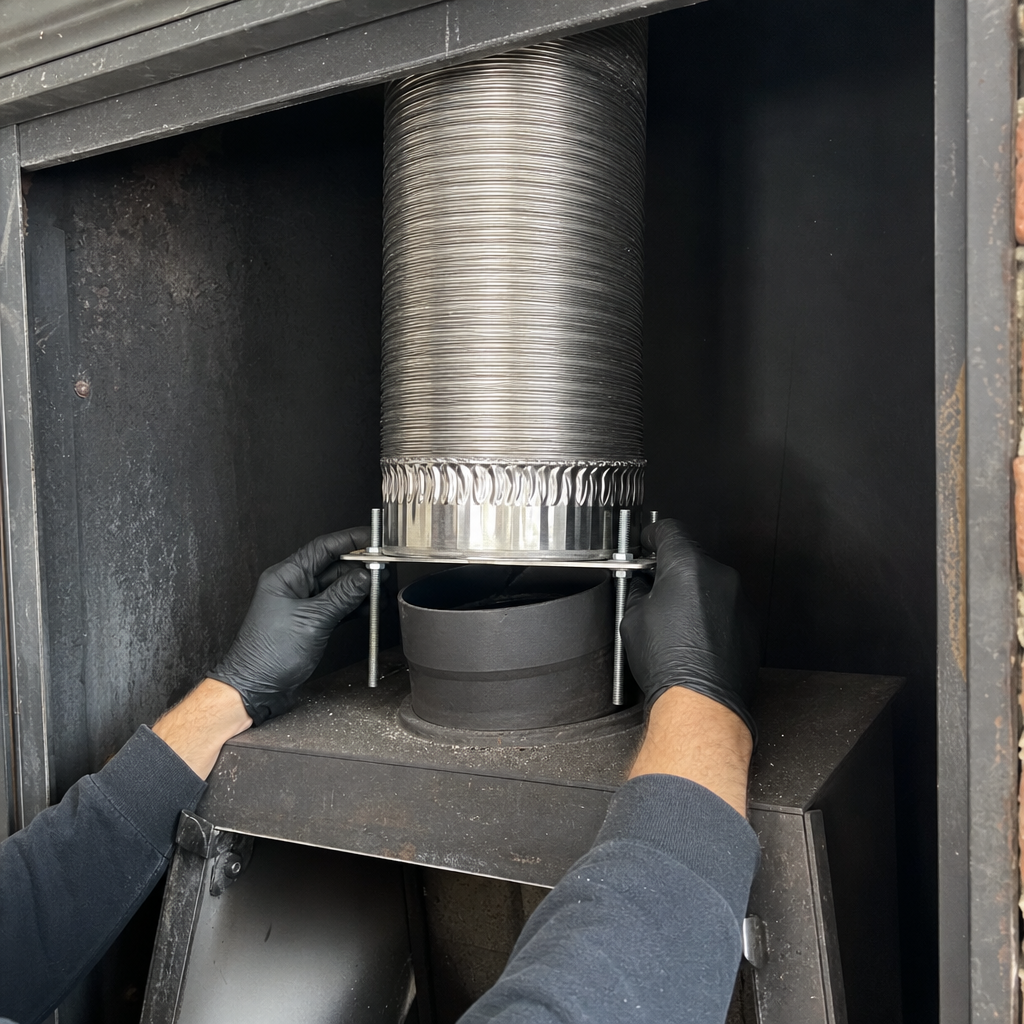
The DuraFlex system is our go-to for the unlined brick flues we find in Rochester’s 1910s–1920s housing. It’s a continuous flexible stainless liner — we specify 316Ti alloy for its acid resistance — that gets insulated and dropped down the existing flue, then connected to the appliance with proper termination. The insulation matters for Rochester specifically: our prolonged near-freezing cycles mean flue gases stay cooler longer, and an uninsulated liner can drop below the dew point and condense even when sized correctly. We don’t skip that step.
HeatShield is the option most generalists can’t offer, and it’s where Anthony’s pattern recognition pays off for homeowners. If your clay tile liner has surface cracking, minor mortar loss between tiles, or shallow spalling — but the tiles themselves are structurally sound and properly sized — HeatShield’s cerfractory slurry can restore that surface to better-than-new condition. It’s a sprayed or troweled application that fills gaps, seals cracks, and creates a smooth, insulated flue path without removing the existing structure. We’ve saved Corn Hill and 19th Ward homeowners thousands by identifying HeatShield candidates that a less experienced eye would have condemned to full relining. The catch: the clay tile skeleton has to be sound. Anthony makes that call at inspection, not from a desk.
We source DuraFlex, HeatShield, and Olympia Chimney components directly — never commodity supplies from a big-box store. The brand matters because these systems carry manufacturer warranties that require certified installation and specified materials. A handyman special with unlisted flex pipe voids your warranty and your homeowner’s insurance if something goes wrong.
What Drives Liner Cost Higher or Lower in Rochester
The table above gives honest ranges, but every job has variables. Here’s what moves the needle in our market:
- Flue condition and access: A straight, unlined brick flue in a two-story South Wedge duplex with good roof access runs toward the lower end. A three-story Corn Hill rowhouse with offset flues, a steep slate roof, and active water damage from a failed crown pushes toward the higher end — or requires crown and masonry repair before liner work can begin.
- Appliance connection complexity: Connecting a liner to a modern high-efficiency gas furnace with a powered ventor requires different termination and sizing than a wood-burning fireplace insert. Multi-appliance flues — still common in Rochester’s converted two-families — need separate liner passages or proper sizing for combined load.
- Permit and inspection requirements: The City of Rochester and surrounding Monroe County municipalities require permits for liner installation and final inspection for gas appliance connections. We handle permitting as part of our scope; the cost is included in our quotes, not tacked on.
- Seasonal timing: Fall rush pricing isn’t a thing with us, but availability is. We book inspections 2–3 weeks out by October. Scheduling your inspection in spring or summer means we can address any liner needs before heating season, and you’re not calling with a CO detector screaming.
Here’s a detail competitors miss: Rochester’s dense neighborhood housing means we often can’t stage materials in a driveway or drop a liner from a boom truck. We’re working from ladders on narrow lots, sometimes coordinating with neighbors for access. That logistical reality is built into our quotes, not discovered as a surprise charge mid-job.
The Cost of Not Relining: What We’ve Seen in 20 Years
Anthony grew up in Rochester’s North Winton Village, where houses are old, winters are long, and every third home has a fireplace that hasn’t been properly looked at in a decade. His father heated their house with a wood stove, which is part of why he takes carbon monoxide and creosote risks personally — not just professionally. That background shows up in how we talk about the cost of deferring liner work.
We’ve opened flues in 19th Ward homes where the unlined brick has deteriorated so severely that exhaust was filtering through the masonry into a child’s bedroom above. We’ve found gas water heaters in Swillburg basements venting into chimneys with missing mortar joints at every floor level — the CO path was literally the path of least resistance into the living space above. These aren’t hypotheticals; they’re inspections from the last two years.
The financial math of deferral doesn’t work. A $3,500 liner installation prevents:
- Carbon monoxide exposure with potential medical or legal liability
- Masonry rebuilds that run $8,000–$15,000 when the flue collapses or the stack tilts
- Insurance claims denied because the chimney wasn’t maintained to code
- Failed home inspections when you sell — a common surprise in Rochester’s active real estate market
We’re not alarmists. But we’re also not going to soft-pedal what an open brick flue means when it’s venting combustion gases. Anthony’s seen the outcomes, and his assessment at your inspection will tell you exactly where you stand.
Why Owner-As-Technician Matters for Liner Work
Here’s the practical difference: when you call Premier Chimney Cleaning, Anthony Perez shows up on your job. Not a rotating franchise crew. Not a subcontractor who took a weekend certification. The same person who’s installed liners across Rochester for 20 years, who’s seen how DuraFlex performs in our freeze-thaw cycles, who’s made the HeatShield-or-full-liner call hundreds of times.
Nearly 700 homeowners have trusted us with their chimney work, and that volume matters because it means our recommendations are pattern-based, not guesswork. Anthony can walk your roof in South Wedge, look down your flue, and tell you whether he’s seen that exact deterioration profile before — because he has. That experience translates to accurate scoping, no unnecessary work, and liner installations that last.
We carry Chimney Liner & Rebuild capabilities from inspection through complete masonry reconstruction if the stack has failed beyond relining. Most jobs don’t need that scope, but having the full capability means we’re not referring you elsewhere when conditions are worse than expected.
FAQs
Expect $2,800–$5,500 for a full DuraFlex stainless steel relining and $1,800–$3,200 for HeatShield ceramic resurfacing on a structurally sound clay tile flue. The older your home — particularly pre-1930s construction in neighborhoods like South Wedge or Corn Hill — the more likely you’ll need the full relining due to unlined brick or deteriorated original tile. Call (888) 399-5696 for a free inspection and exact quote.
HeatShield resurfacing costs 30–40% less than full stainless relining when your existing clay tile liner is structurally sound but surface-damaged. However, unlined brick flues or collapsed tile require full replacement — resurfacing won’t adhere to bare brick or missing substrate. Anthony assesses this at inspection; we’ve saved Rochester homeowners thousands by identifying HeatShield candidates that less experienced techs would have condemned to full replacement.
We typically schedule installation within 3–5 business days of inspection, not same-day, because liner jobs require material verification and often permitting. For urgent CO hazards or failed heating systems, we can expedite. Call (888) 399-5696 and we’ll prioritize safety-critical situations — we’ve done emergency relinings in January when a flue failure left a family without heat.
If your chimney was built before 1940 and has never been relined — common in Rochester’s 19th Ward, Maplewood, and Swillburg housing stock — it likely needs at least inspection with a chimney camera to verify liner condition. Signs of trouble include white efflorescence on exterior brick (condensation damage), rusted damper or firebox components, or a gas appliance connected to an obviously oversized flue. Annual NFPA 211 inspection is the only reliable way to know; we find problems homeowners can’t see from the firebox.
Get Your Rochester Chimney Liner Assessment
Don’t guess about your flue condition — and don’t trust a national cost guide that doesn’t know Rochester’s housing stock. Anthony Perez will inspect your chimney personally, explain what you’re actually looking at, and quote only the work you need. Free estimates, upfront pricing, and 20 years of pattern recognition on every job. Call (888) 399-5696 or reach out through our home page to schedule.
Written by Anthony Perez, Owner & Lead Technician at Premier Chimney Cleaning Greater Rochester, serving Rochester, NY.